

On the day that I make my annual trek to Cooperstown for Baseball Hall of Fame Induction Weekend, I thought it would be interesting to share an experience from last summer when I visited a completely different museum celebrating the history of America’s pastime.
The neighborhood of Kansas City commonly know as 18th and Vine is considered by some to be the birthplace of jazz, or at least a newer style of jazz born in the 1930s. It is also in this neighborhood, at the Paseo YMCA, that Rube Foster and other future executives of the Negro National League met to discuss the organization of the league in 1920. This quaint little section, located just east of downtown, is now the home of two fine museums, each celebrating their respective, and uniquely American, traditions.
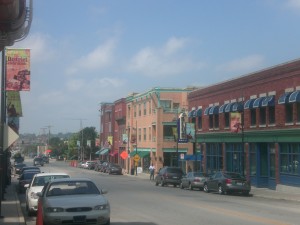
The Negro Leagues Baseball Museum was founded in 1990 to preserve the history of African-American baseball. Negro League baseball existed prior to the formation of the Negro National League in 1920, but it was Foster’s vision to create the league that is now considered the first lasting professional league for African-American players. Unfortunately, health problems resulting from a gas leak that nearly asphyxiated him took his life in 1930, and that first league folded the following year. However, a new Negro National League was formed in 1933, followed by the Negro American League in 1937, and African-American baseball flourished until Major League Baseball became fully integrated in the late 1950s. Rube Foster, honored primarily for his accomplishments as the chief pioneer of the Negro Leagues, but also for his playing and managerial careers, was inducted into the National Baseball Hall of Fame in 1981.
The museum is an impressive tribute to this rich history, which dates back to the mid-19th century, well before the official organization of the Negro National League. In addition to the standard baseball artifacts, many of the exhibits include the artwork of the period, so unfortunately, the taking of photographs is not permitted. However, it costs just $8 for admission to both the Negro Leagues Museum and the neighboring American Jazz Museum, so I highly recommend a visit if you ever have the opportunity. One of my favorite aspects of the Negro Leagues Museum is a time line of events of the Civil Rights movement that places the history of African-American baseball in its historical perspective.
A few other interesting facts I learned there:
–J.L. Wilkinson, the original owner of the Kansas City Monarchs, was the only white member of Rube Foster’s trusted inner circle. In 1930, his Monarchs became the first professional team to play night baseball. He was elected to the Hall of Fame, with 16 other Negro League and pre-Negro League greats, in 2006.
–Buck O’Neil, the first African-American coach in Major League Baseball history, and honorary Chairman of the Board of the museum until his death in 2006, was never allowed to set foot on a Major League field.
–King Solomon White, also inducted into the Hall of Fame in 2006, wrote the first definitive history of African-American baseball, titled Sol White’s History of Colored Baseball, in 1907.
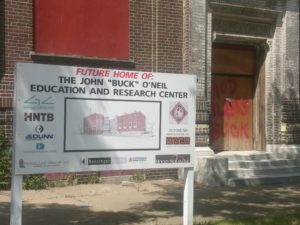
–The nearby Paseo YMCA (shown below with “God Bless Buck” graffiti on the boarded-up door), the original Negro National League meeting place, is the future home of the John “Buck” O’Neil Education and Research Center.
Finally, I’ll finish with a trivia question: Of course, everyone knows that, in 1947, the Brooklyn Dodgers, with Jackie Robinson, became the first major league team to integrate; and most everyone knows that, later that year, the Cleveland Indians became the first integrated American League team, by signing Larry Doby. What may not be common knowledge, though, is who was the third team to integrate (also in 1947) and who was the player?
Was the player Monte Irvin (Giants)??
Chas,
Great article. I have been fortunate to tour the Negro Leagues Baseball Musuem and it is fantastic facility. Unfortunate that most of the players were never able to touch a major league field – but it is a great place to acknowledge their contribution to the game of baseball.
When I was there, Buck O’Neill was supposed to give us a tour of the building. Unfortunately Mr. O’Neill didn’t feel well and wasn’t able to attend. Instead he autographed about 40 baseballs and had them waiting for us. He died shortly afterwards and that baseball has been one of my most prized posessions since.
Great stuff, Chas. I had no idea that the museum was in KC. A KC/St. Louis trip would be quite the trip for baseball purists. Glad we have ‘the bench’ for articles like these because othrwise I might not have ever known.
Sorry guys, forgot to respond to Wally’s trivia answer. No, it wasn’t Monte Irvin. Good guess, though. I suppose since there are no other guesses, I should give the answer:
St. Louis Browns, Hank Thompson: July 17. 1947
https://en.wikipedia.org/wiki/List_of_first_black_Major_League_Baseball_players_by_team_and_date